
THE NEXT FRONTIER
A space innovation workshop, hackathon kickoff, and research-to-prototype toolkit. You don't have to be a rocket scientist to build something that matters.
In-person: ECPI University, Virginia Beach campus
Hosted with: AI Collective Hampton Roads × ECPI

Pitch before you build.
Start with a real problem. Research it. Explain why it matters. Get feedback. Then build a solution people actually need. Our ambition is to help a Hampton Roads team develop a project competitive on the global stage.
Three days. One launchpad.
Innovation Workshop
6–8 PM · ECPI Virginia Beach
Discover NASA-inspired challenges, learn credible research methods, meet collaborators, and develop your first pitch.
Kickoff + Idea Pitches
11 AM–2 PM · ECPI Virginia Beach
Present a three-minute concept before building, receive feedback, form teams, and plan your prototype.
Build + Share
Independent / online
Continue building, prepare a demonstration, follow official competition rules, and share your work with the community.
Know before you go
A YouTube video introducing the schedule, research tools, pitch process, and what to bring will appear here.
YouTube embed placeholder — ready to replace with your video URL.Start here
New to hackathons or scientific research? Start with a question, not a coding language.
Step 1 · Choose a problem
Explore challenges and NASA's science priorities. Find a question you genuinely want to investigate.
Step 2 · Research responsibly
Find original sources, record assumptions, check evidence, and describe what you do not know.
Step 3 · Shape your proposal
Turn your research into a clear project concept with the proposal workbook.
Step 4 · Pitch the concept
Practice a concise explanation and get feedback before spending hours building.
Step 5 · Meet your team
Combine different strengths: research, engineering, storytelling, visual design, and community insight.
Step 6 · Build and test
Prototype the smallest useful demonstration. Include software, hardware, or both.
What to bring
A laptop or notebook if available, charger, curiosity, a few questions, and willingness to collaborate. You do not need a finished idea or previous programming experience.
Explore the frontier
Space needs more than astronauts. Select a discipline and imagine what you could contribute.
Where do the ideas come from?
Start with NASA's Decadal Surveys—community-developed research priorities for fields such as planetary science, astronomy, Earth science, and biological/physical sciences. Read the science questions, then translate a specific gap into a project you can test.
Build with hardware? Absolutely.
Show the software layer of your hardware idea separately: sensor readings, control logic, a simulation, dashboard, or app. Then explain the physical components, how they connect, and what you could safely prototype.
Hardware + software example
Coastal sensor station: design a low-cost water-level sensor; build a mock dashboard with sample data; document the physical wiring and a validation plan.
AI-assisted 3D design
Write a precise design brief with dimensions and constraints. Use an AI tool for concept sketches, then model in a CAD tool such as Tinkercad or Onshape. Verify dimensions, clearances, and printability manually. AI concepts are not engineering validation.
Citizen science & research basics
Anyone can contribute to scientific discovery. Good research requires transparent methods, credible sources, and honest conclusions.
Research workflow
- Write a focused research question.
- Define the population, environment, or system.
- Search original NASA sources and peer-reviewed papers.
- Record what each source actually demonstrates.
- Form a testable hypothesis or design requirement.
- Choose data and a reproducible method.
- Document limitations, uncertainty, and next tests.
Evidence checklist
- Is the source primary, reputable, and relevant?
- What date, dataset, and methodology were used?
- Does the evidence support the exact claim?
- Can someone reproduce the analysis?
- Did you distinguish facts from assumptions?
- Did you cite data, code, and AI assistance?
From paper to project
Example: Research how coastal communities use Earth observation data → identify a local flood-risk communication gap → prototype a clear, accessible flood-data explainer → test whether people can correctly interpret the visualization.
Opportunities in space
A project can become a learning experience, a career pathway, a research collaboration, or a business idea. These are official starting points; availability and eligibility vary.
Students & emerging researchers
NASA L'SPACE Academy ↗NASA internships ↗NASA learning resources ↗Citizen science projects ↗Careers & local connections
NASA careers ↗USAJOBS ↗NASA Langley Research Center ↗Explore NASA contractors and regional aerospace employers separately; their openings are not necessarily listed by NASA.
Entrepreneurs & small businesses
NASA SBIR / STTR program ↗NASA Technology Transfer ↗Federal contracting opportunities ↗Check current solicitations, award cycles, and eligibility before planning an application.
Proposal lab
A good proposal is a clear argument for why a problem matters and how you will investigate or solve it.
Seven questions to answer
- Problem: What is wrong or missing?
- Context: Why does it matter now?
- Audience: Who experiences the problem?
- Evidence: What research supports your claims?
- Solution: What exactly will you build?
- Validation: How will you know it works?
- Resources: What data, people, tools, and time are needed?
Example concept
Title: CoastWatch for Students
Problem: Coastal hazard datasets can be difficult for new learners to interpret.
Proposal: Build a beginner-friendly visualization using a documented public dataset, with clear legends, sources, and limitations.
Success measure: Can a first-time visitor correctly explain the displayed trend?
Why pitch before you write the full proposal?
A short pitch forces you to explain the problem, the audience, and the value in plain language. Early feedback exposes weak assumptions before you invest in a long proposal or a complex build.
Pitch academy
Three minutes to explain the problem worth solving—before you build it.
| Time | Focus | Question to answer |
|---|---|---|
| 0:00–0:30 | Hook + problem | What is the unmet need? |
| 0:30–1:00 | Evidence | How do we know this problem exists? |
| 1:00–1:45 | Proposed solution | What would you build? |
| 1:45–2:15 | Method | What data, hardware, or software will you use? |
| 2:15–2:45 | Impact + validation | Who benefits and how will you test it? |
| 2:45–3:00 | Close | What should we remember? |
Practice timer
Pitch checklist
- State one specific problem.
- Use one strong piece of evidence.
- Explain the proposed solution simply.
- Say what you can realistically demonstrate.
- Identify who benefits.
- End with a clear next step.
Pitch presentation template
Here is the seven-slide deck, shown slide by slide. Every bracketed line is a prompt—replace it with your team's own words, keep one idea per slide, and stay inside three minutes.
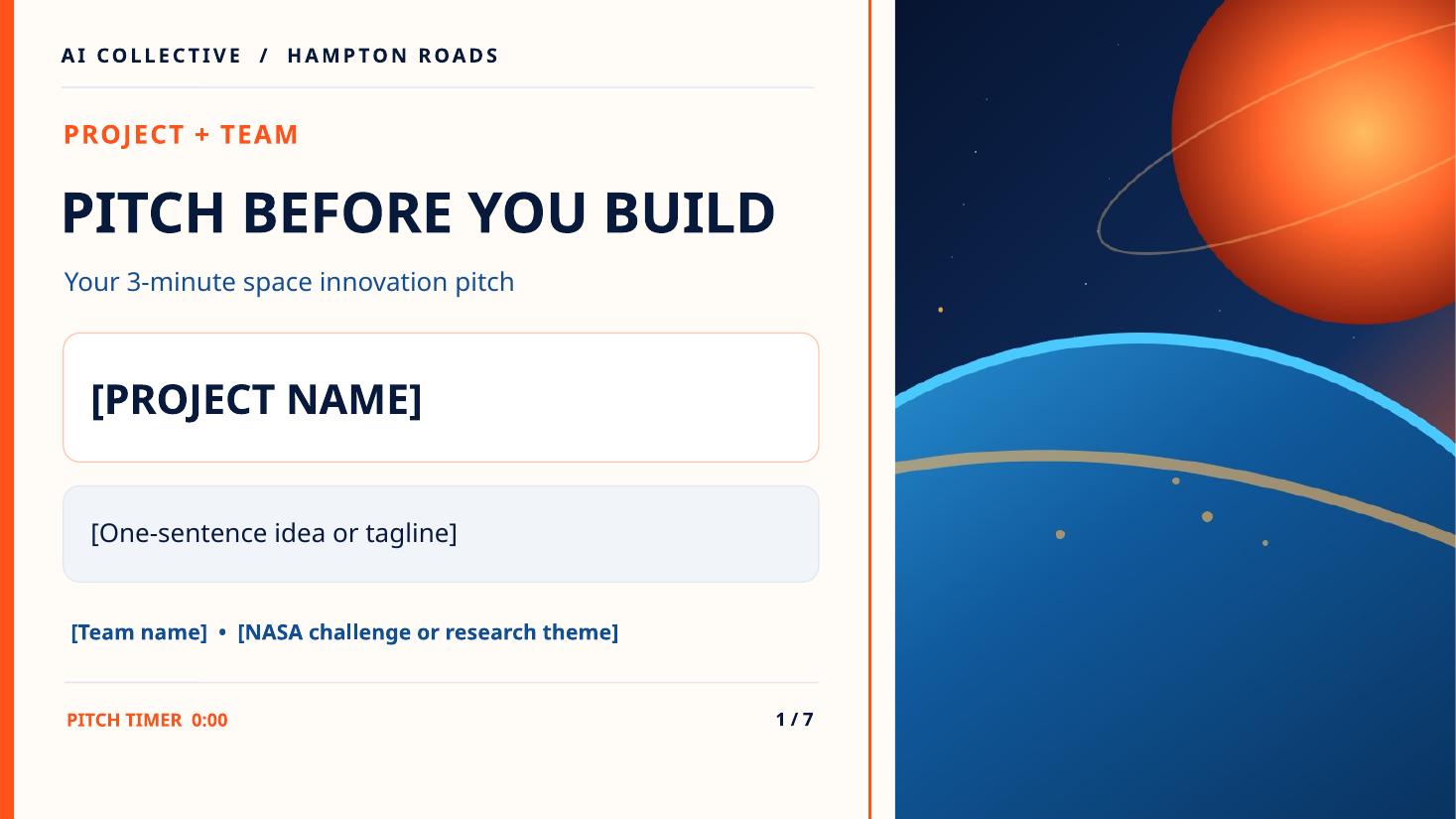
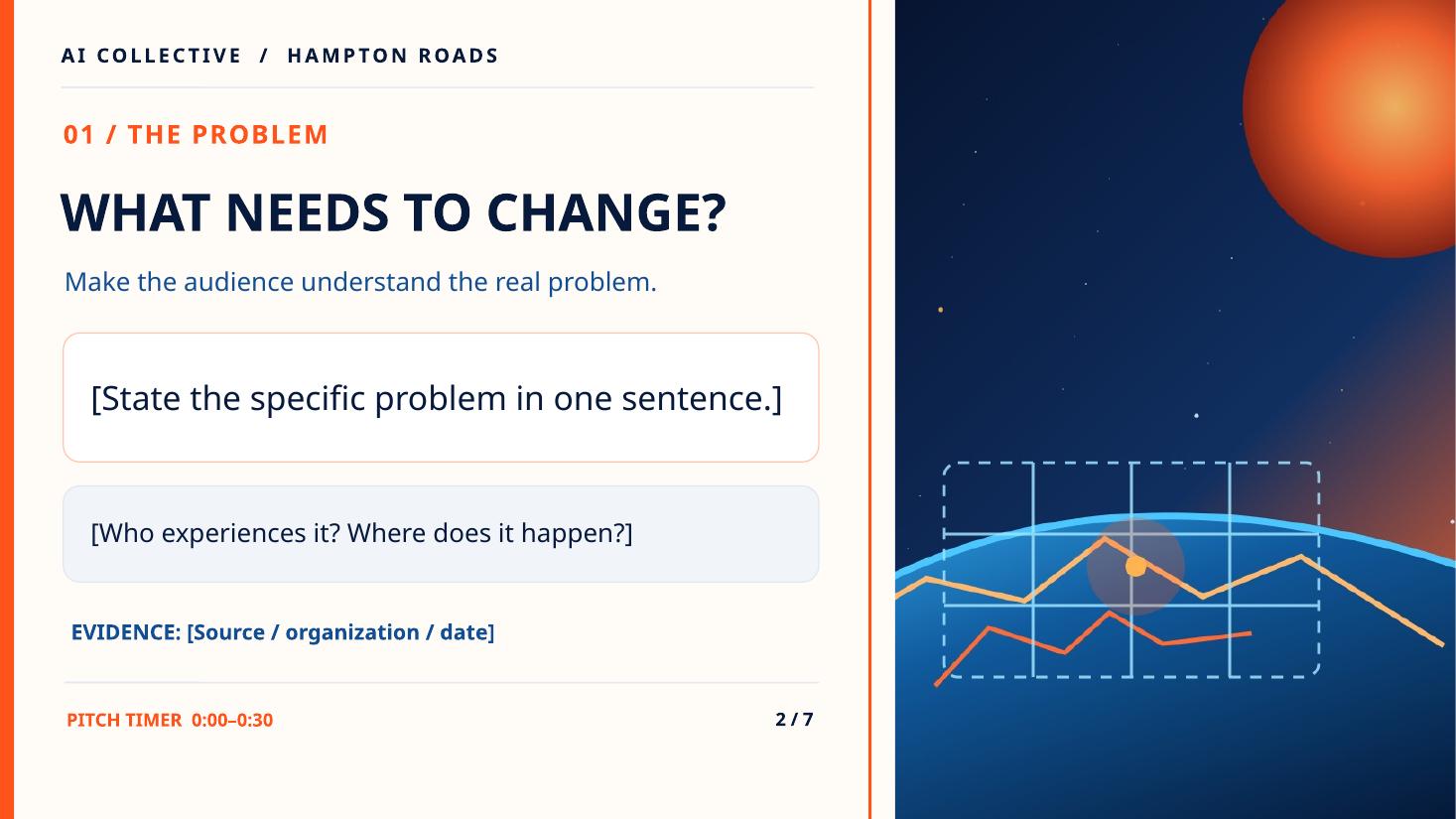
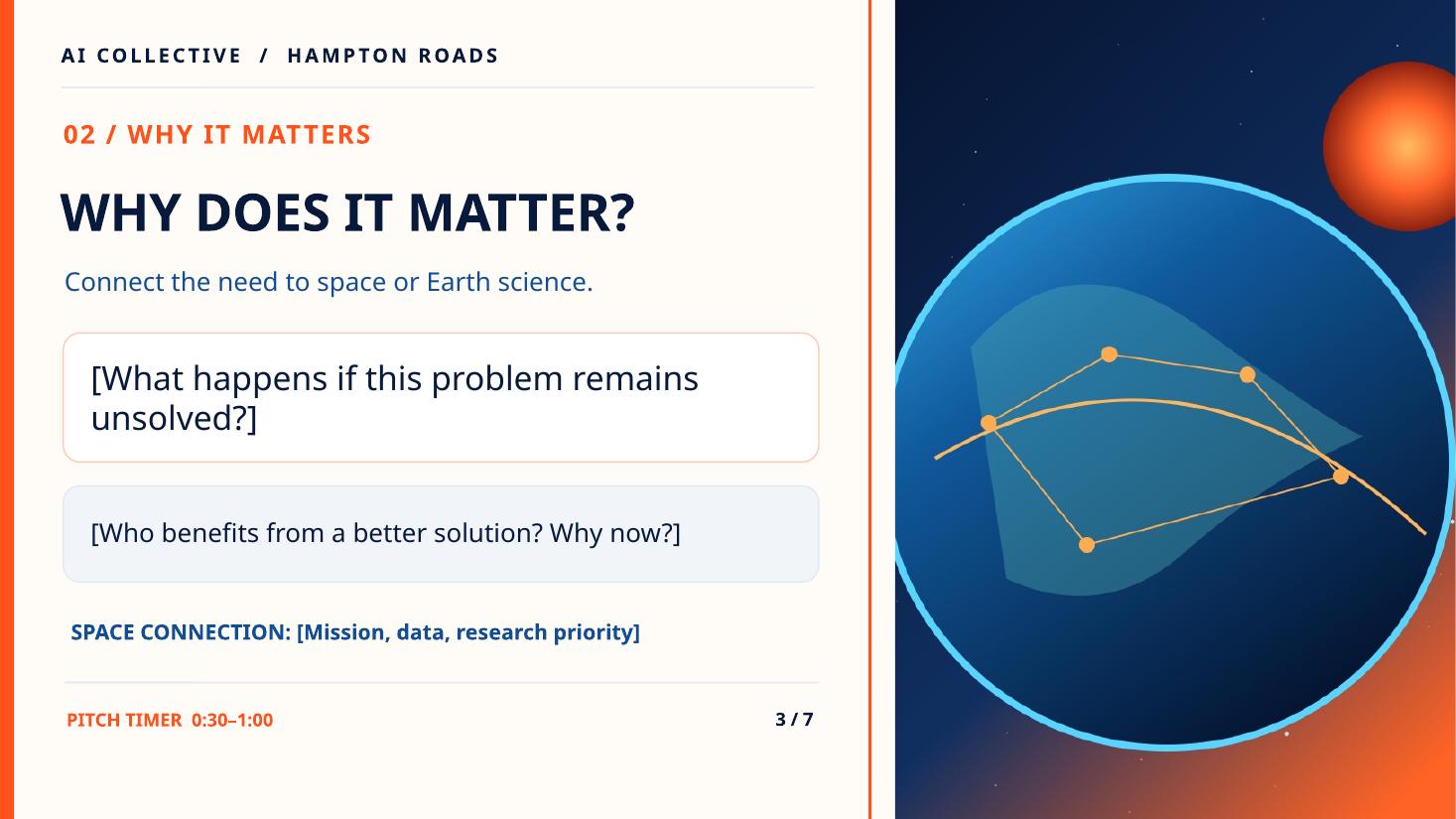
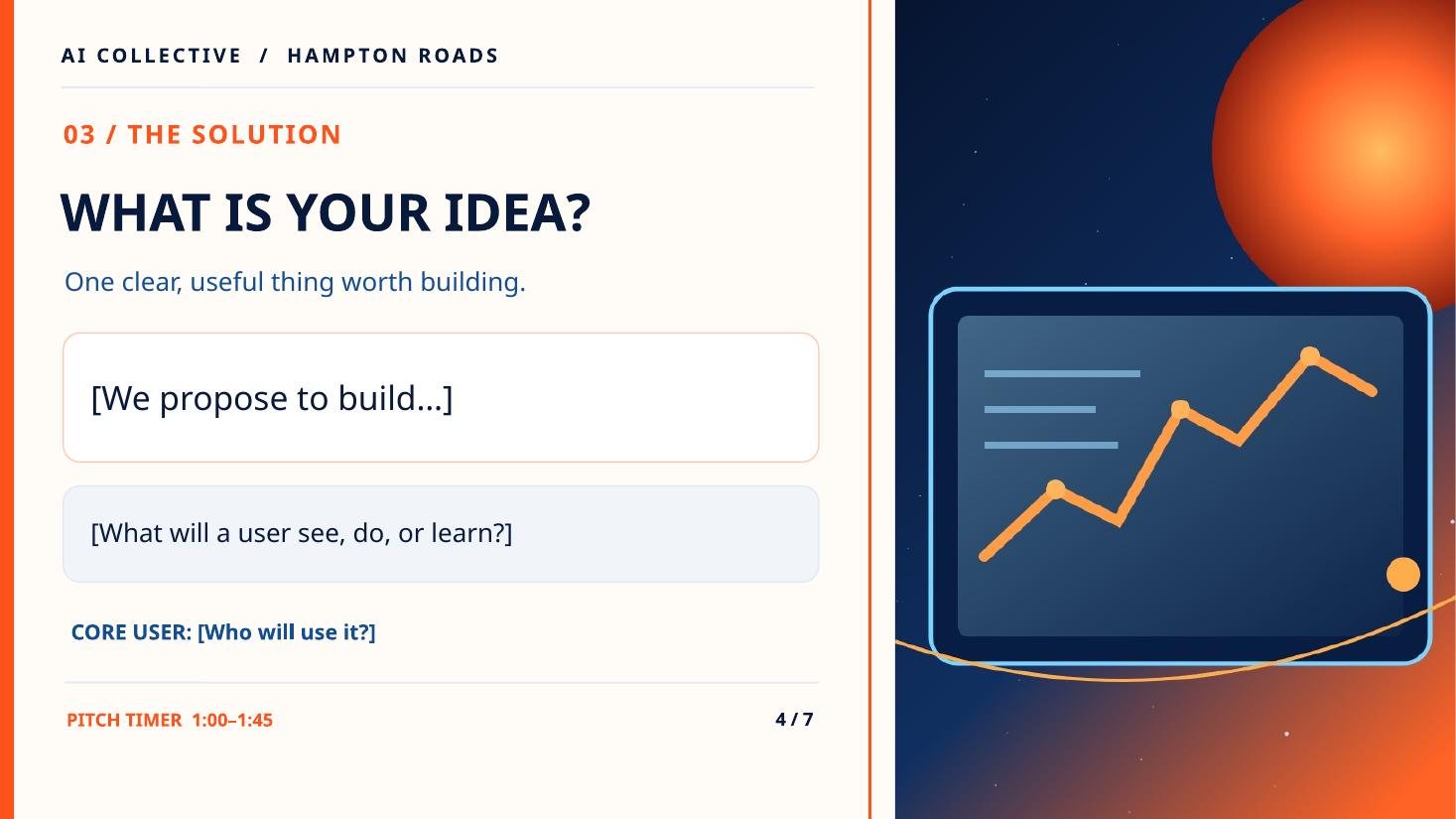
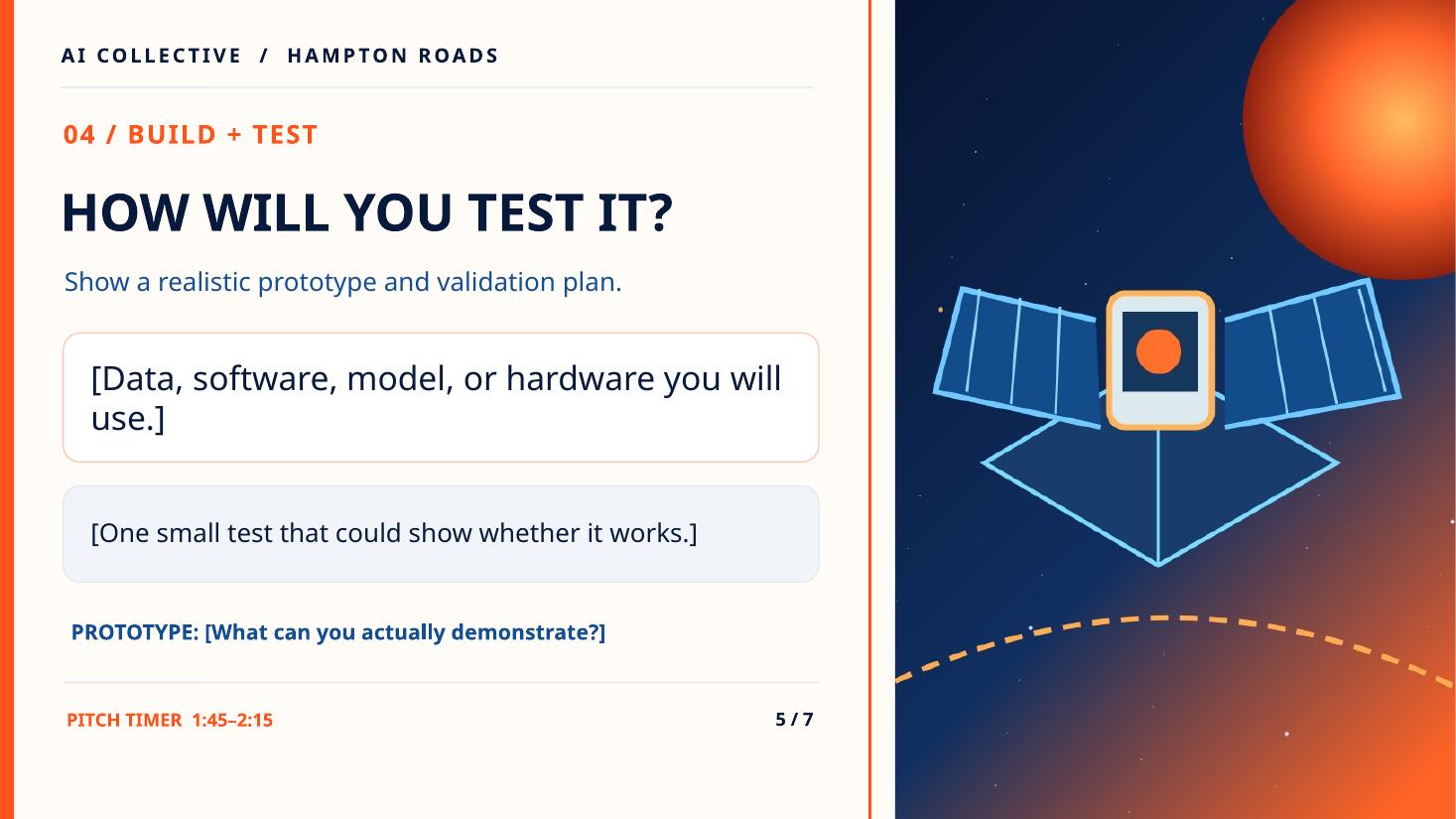
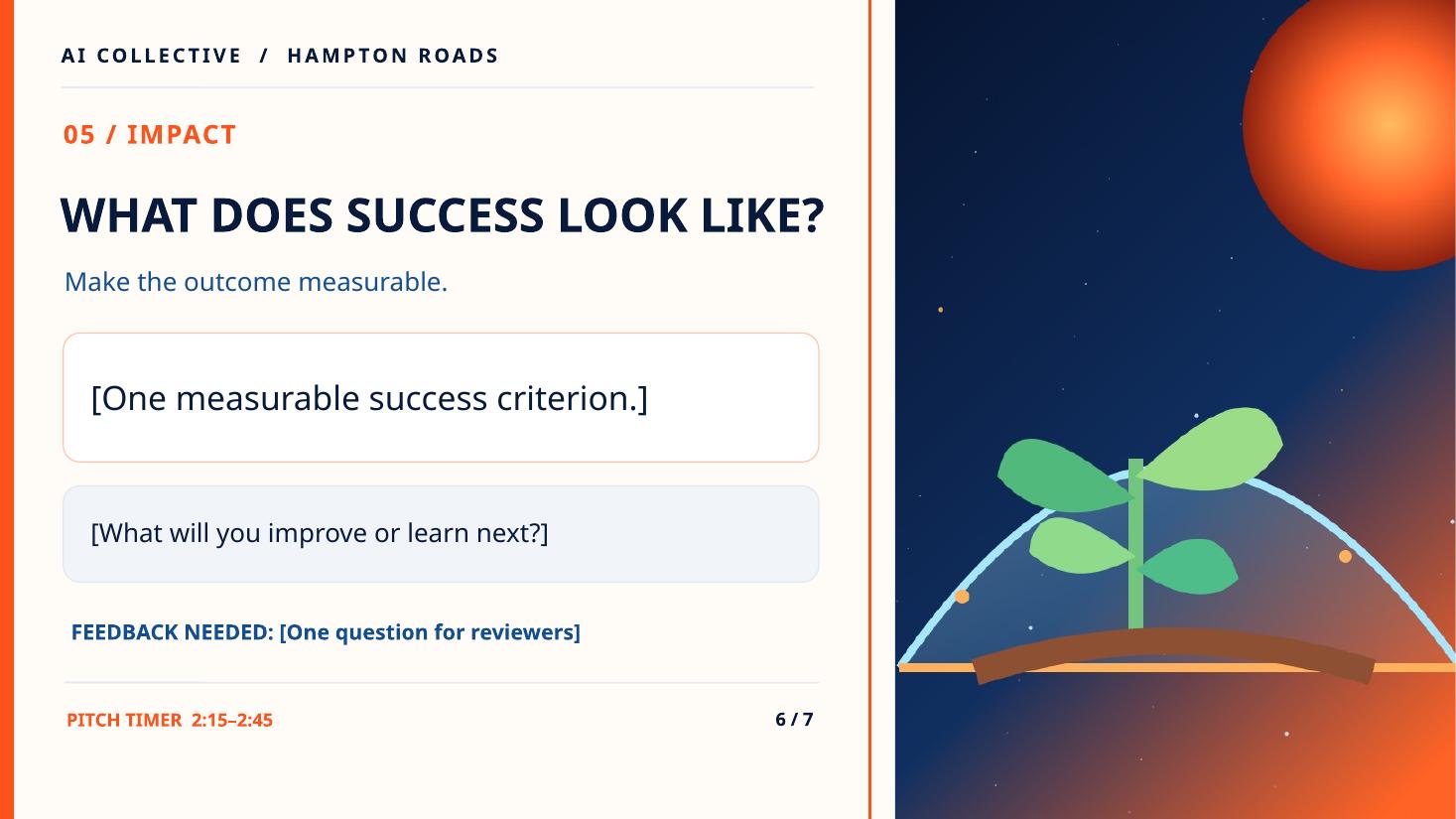
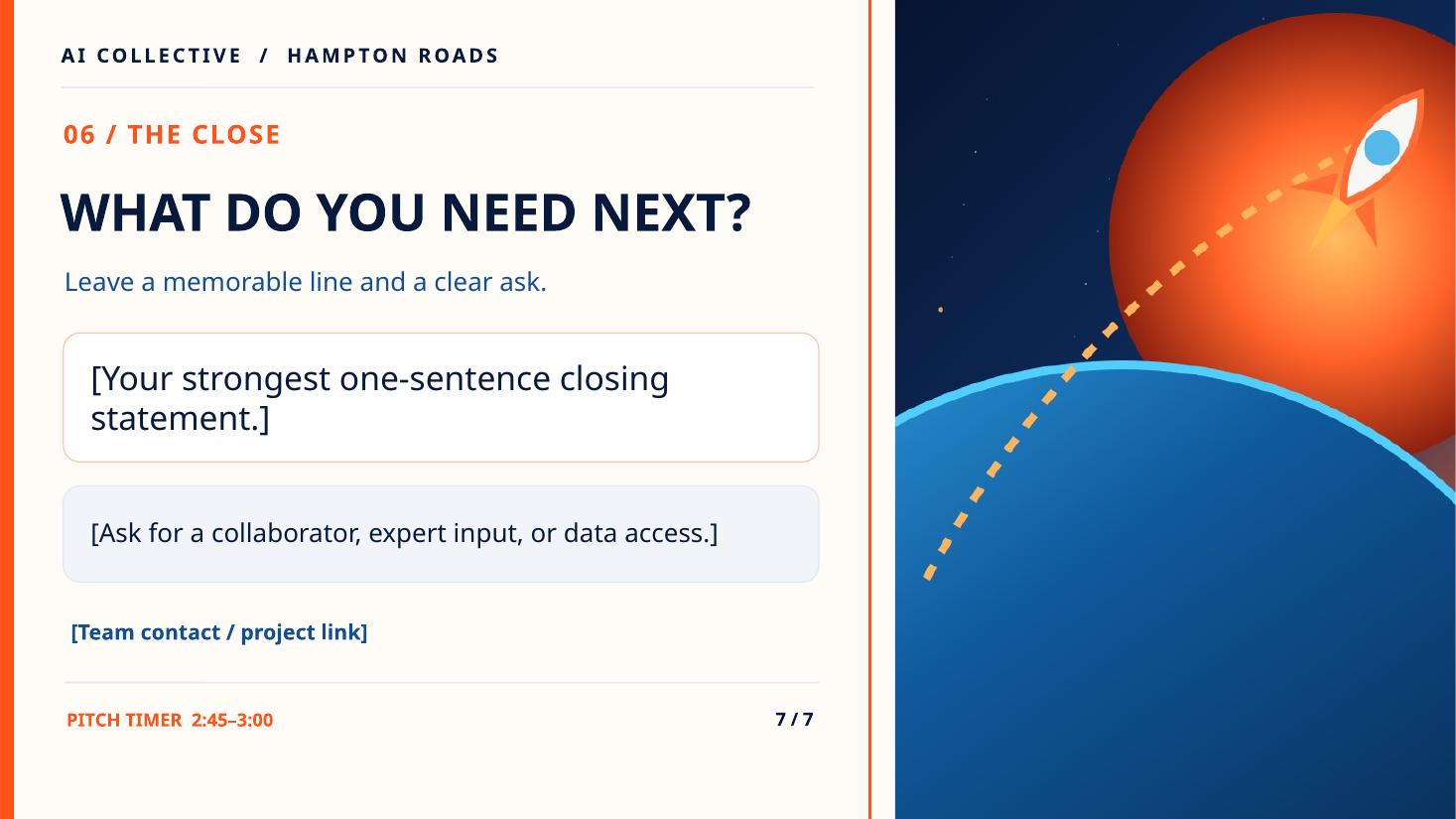
The file is fully editable—open it in PowerPoint, Google Slides, or Keynote and fill in the brackets with your team's answers.
Event guide
| When | Where | What happens |
|---|---|---|
| The Launchpad · Fri Nov 13 · 6–8 PM | ECPI Virginia Beach | Pitch Before You Build: idea development, scientific resources, and pitching workshop |
| Mission Control · Sat Nov 14 · 11 AM–2 PM | ECPI Virginia Beach | Official kickoff: share early ideas, get feedback, meet potential teammates |
| Nov 14–15 | Independent / online | Build, test, document, and follow official challenge requirements |
| The Final Stretch · Sun Nov 15 · 5 PM | Online via Discord | Reconnect, share progress, ask questions, and prepare for the final stage |
Saturday pitch feedback rubric
This rubric rewards a promising, researched idea—not a finished product. The scoring model is a proposed event rubric and may be refined before the workshop.
| Criteria | Points | What reviewers look for |
|---|---|---|
| Problem definition | 20 | Specific, understandable unmet need |
| Creativity + innovation | 20 | Fresh, thoughtful approach |
| Science / technical relevance | 15 | Appropriate evidence and space connection |
| Feasibility | 15 | Realistic first prototype |
| Potential impact | 15 | Clear beneficiaries and value |
| Communication | 10 | Clear and engaging explanation |
| Timing | 5 | Within three minutes |
| Total | 100 | Feedback first, building second |
Frequently asked questions
Do I need to know how to code?
No. Researchers, designers, artists, communicators, and builders all contribute.
Can middle and high school students attend?
Yes, the event is intended to welcome the wider community. Any age-related registration, supervision, and official competition requirements must be checked before participating.
Do I need a finished project on Saturday?
No. Saturday is for pitching your idea before building and getting constructive feedback.
Can I create hardware?
Yes. Show the software, simulation, or interface layer, and describe your hardware design, testing plan, and safety considerations.
Where do I submit to the official competition?
Use the official NASA Space Apps Challenge website and follow its current instructions, deadlines, and eligibility requirements. A community Devpost post is separate and does not replace an official submission.
Are prizes or partner credits included?
Any prizes, credits, and additional partner benefits will be announced only if confirmed.
Meet your teammates
Great space projects are interdisciplinary. Come with an idea, a skill, a question—or just curiosity.
Research lead
Find credible sources, frame hypotheses, define validation.
Builder / engineer
Prototype software, hardware, models, and integrations.
Designer / artist
Make complex ideas understandable, accessible, and memorable.
Data lead
Find datasets, clean and analyze evidence, document uncertainty.
Storyteller / pitch lead
Communicate the problem, demo, impact, and next steps.
Community / business lead
Understand users, adoption, real-world constraints, and partnerships.
Tools & datasets
Science first. Innovation always. You don't need every tool here — choose the resources that support your project and experience level.
Find your scientific question
The National Academies' Decadal Surveys identify the major scientific questions that guide NASA's planning — excellent hackathon inspiration.
Interactive Planetary Science Decadal Survey ↗Planetary Science & Astrobiology Report ↗NASA Earth Science Decadal Surveys ↗NASA Decadal Survey Collection ↗Google Scholar ↗PubMed Central ↗OpenAlex ↗NASA open data & Earth observation
NASA Earthdata ↗NASA Open Data ↗NASA Planetary Data System ↗NASA Exoplanet Archive ↗NASA APIs ↗NASA Worldview ↗NOAA Digital Coast ↗USGS EarthExplorer ↗Development, design & prototyping
GitHub ↗Replit ↗Streamlit ↗Vercel ↗Figma ↗Canva ↗Tinkercad ↗Onshape ↗Using AI responsibly
Use AI to brainstorm, explain concepts, sketch interfaces, or draft code. Verify scientific claims against original sources; test generated code; check generated 3D designs in CAD; and disclose meaningful AI assistance in your project.
Innovation showcase
Your project shouldn't disappear after the weekend. We want a public record of what Hampton Roads builds—and a way to celebrate work that continues.
Official competition submission
Use the official NASA Space Apps Challenge website for any competition entry, following its current rules and deadlines.
Official Space Apps site ↗Next Frontier community Devpost
Separately, share a final demo, project description, team credits, screenshots, and links in our community gallery.
Open community Devpost ↗Social media & event kit
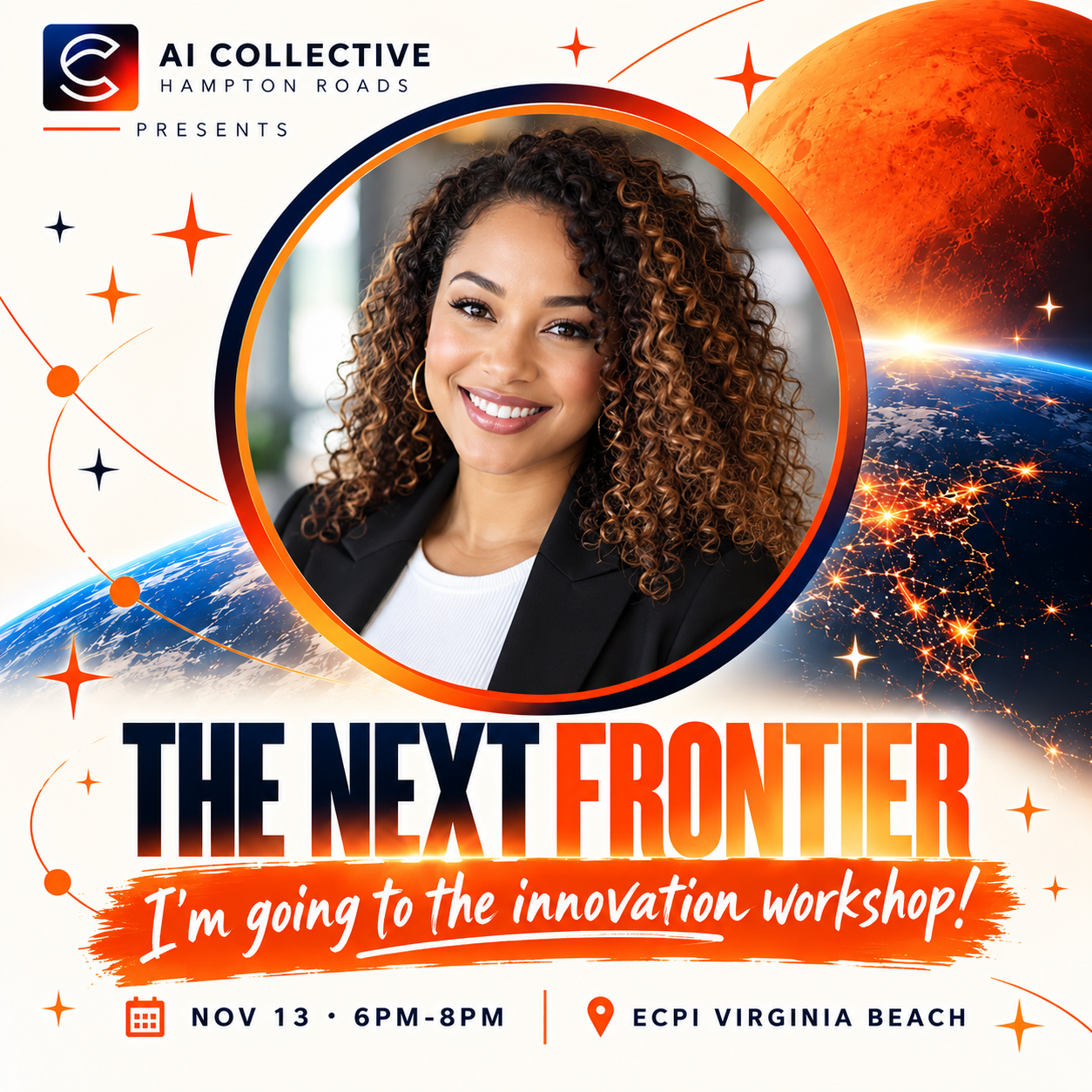
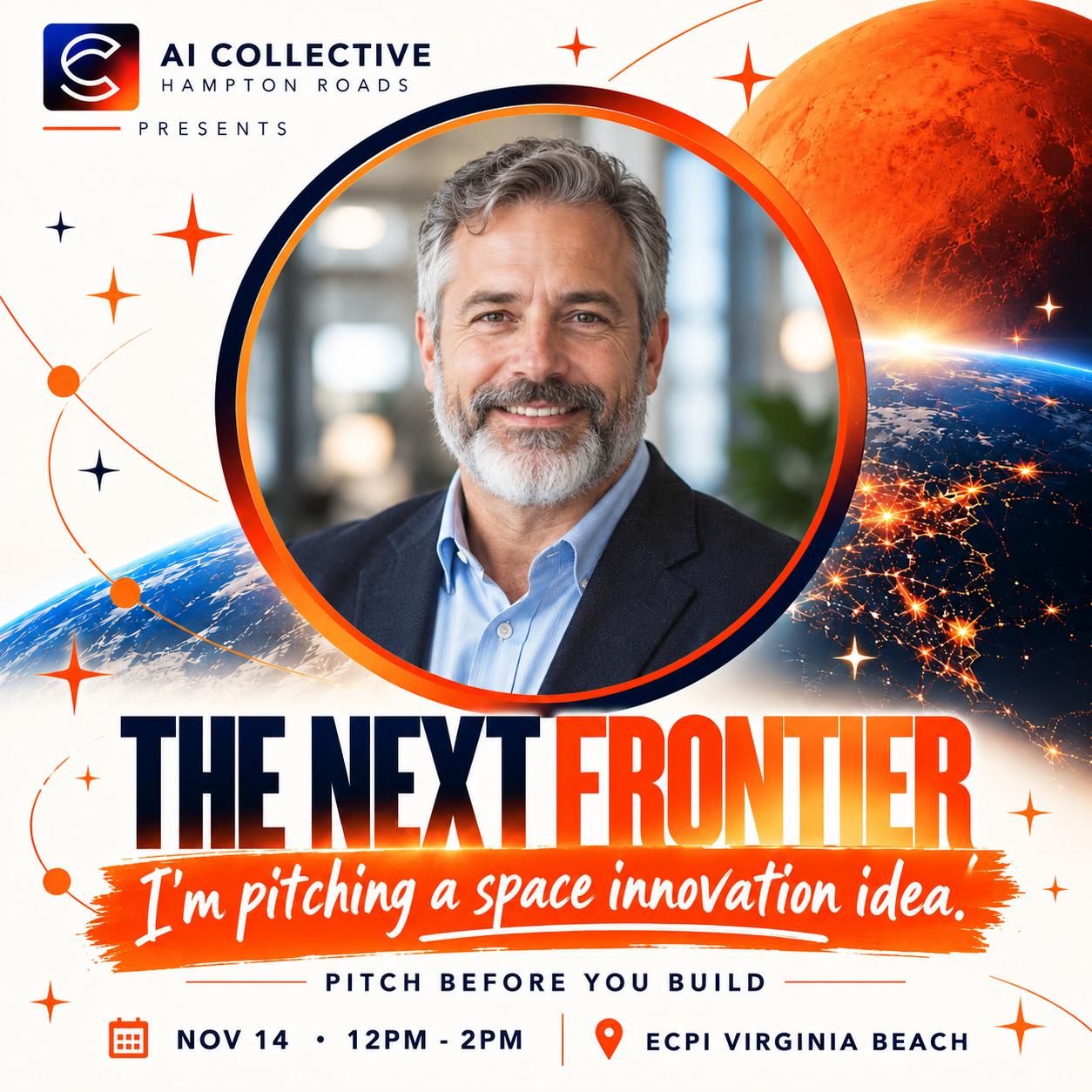
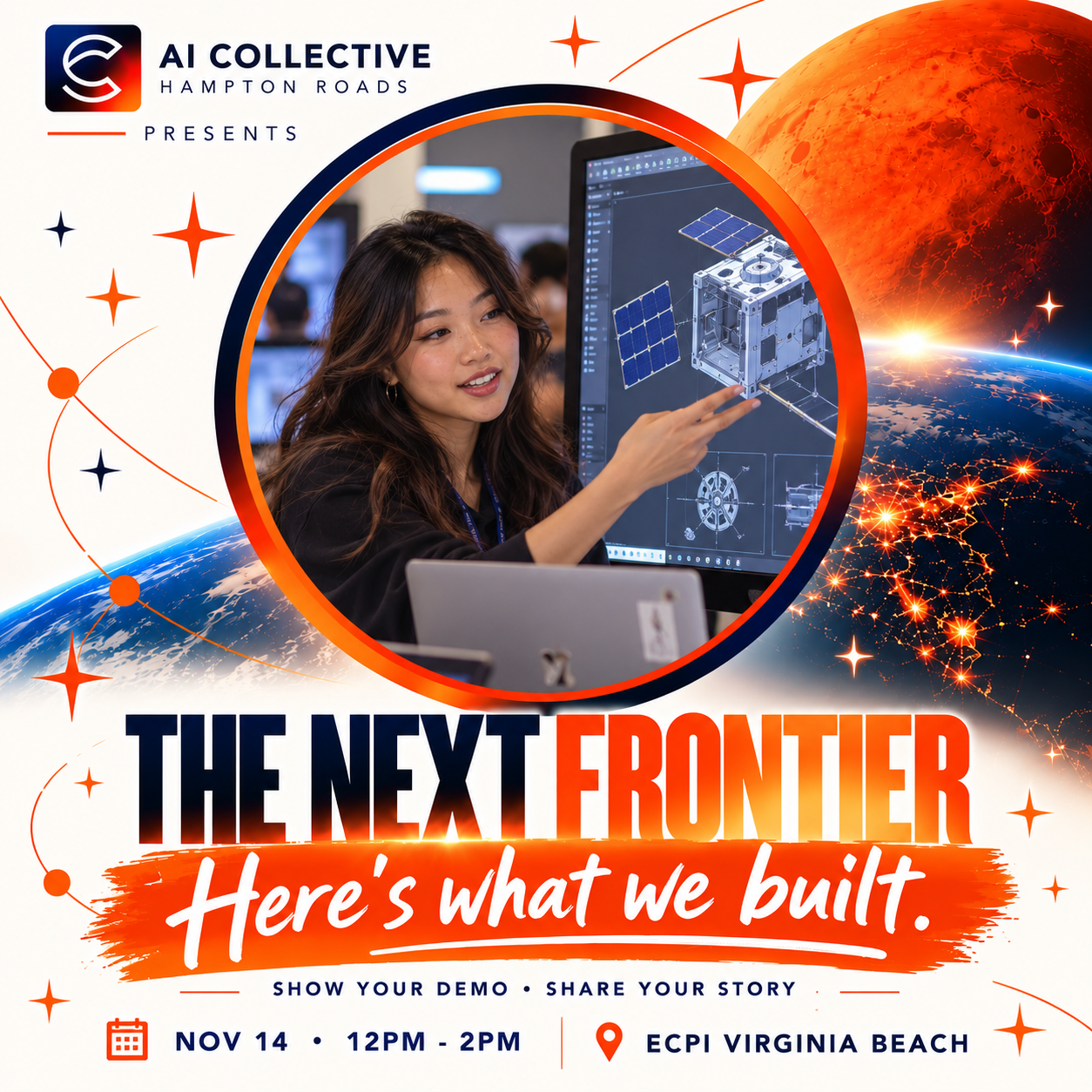
Let Hampton Roads see you doing science. Share your start, your first pitch, your progress, and your final demonstration.
Suggested posting moments
Before the workshop
“I'm joining The Next Frontier to explore [space/science question]. What would you build?”
After your first pitch
“Here's the problem our team wants to solve, why it matters, and what feedback we received.”
Final demo
“We built [project] to address [problem]. Here's what works, what we learned, and what comes next.”
Record a clear demo
- Write a 3-minute outline: problem → solution → live demo → evidence → next steps.
- Record your screen and voice using Zoom or a comparable recorder. Use a quiet room and readable text.
- Show the actual prototype, not only slides. For hardware, include safe footage or a simulation.
- Export a widely supported video format, add captions if possible, and test playback.
- Post publicly only with your team's agreement; follow the submission platform's requirements.
What's next? A Hampton Roads science showcase.
We hope to reconnect with builders for future demonstrations, interviews, collaborations, and possibly a community science show. Details are still being developed.
Beyond the hackathon
Publish your process
Document your question, data, method, prototype, limitations, and team credits in a project README.
Strengthen the science
Test your assumptions, collect appropriate feedback, and compare your findings with established research.
Build a portfolio
Link to your demo, repository, presentation, and lessons learned.
Explore opportunities
Look into NASA internships, L'SPACE, citizen science, careers, and small-business programs.
Find collaborators
Reconnect with teammates and regional researchers who share your interests.
Return to the stage
Watch for potential future science showcases and community demonstrations.
Register for The Next Frontier
Free your curiosity. Bring your ideas. Meet the people who can help you build them. Registration happens in three steps.
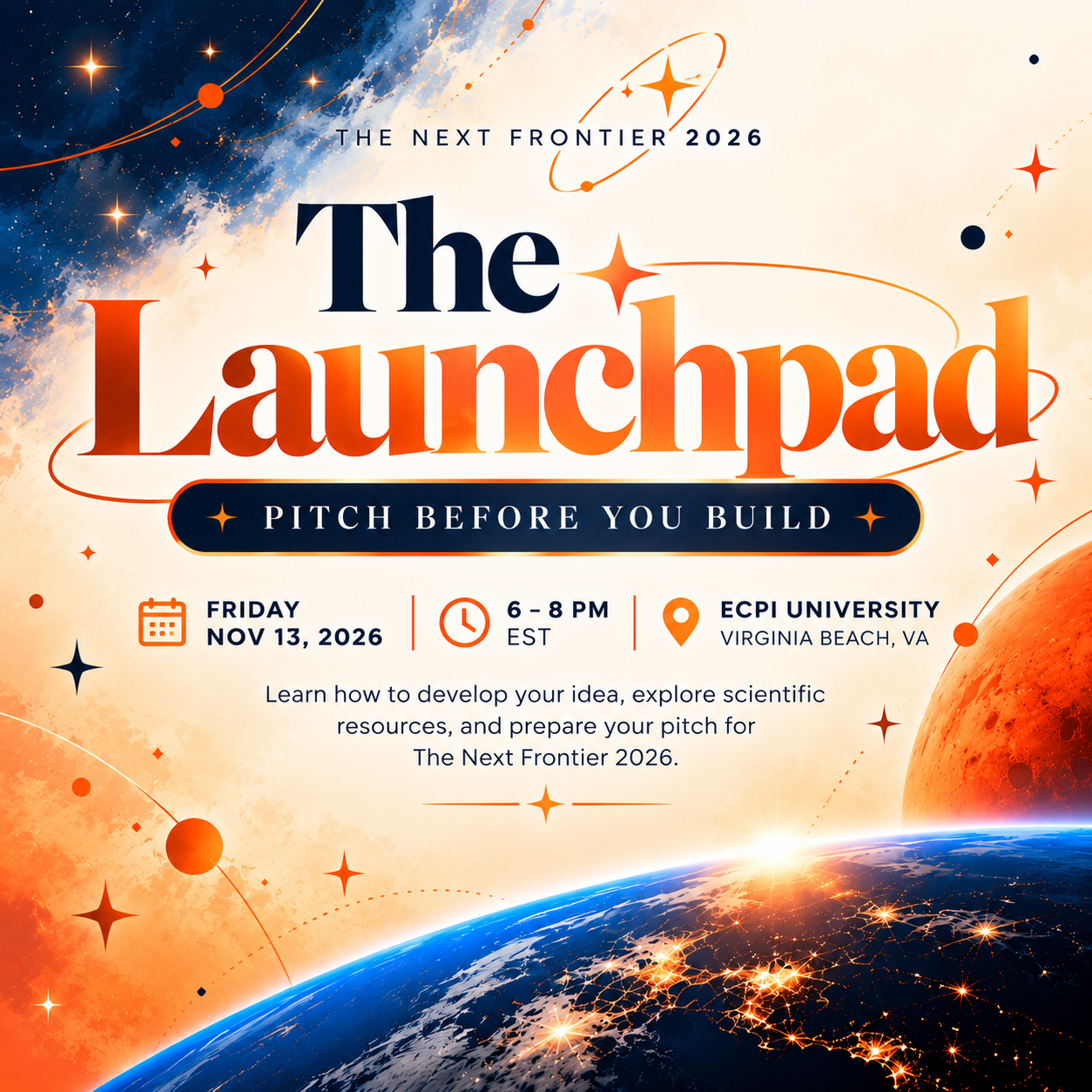 Step 1 · Day 1 · Fri Nov 13, 6–8 PM
The Launchpad
Pitch Before You Build. An interactive workshop on idea development, scientific resources, and effective pitching at ECPI University, Virginia Beach.
Register on Luma ↗RSVP on Meetup ↗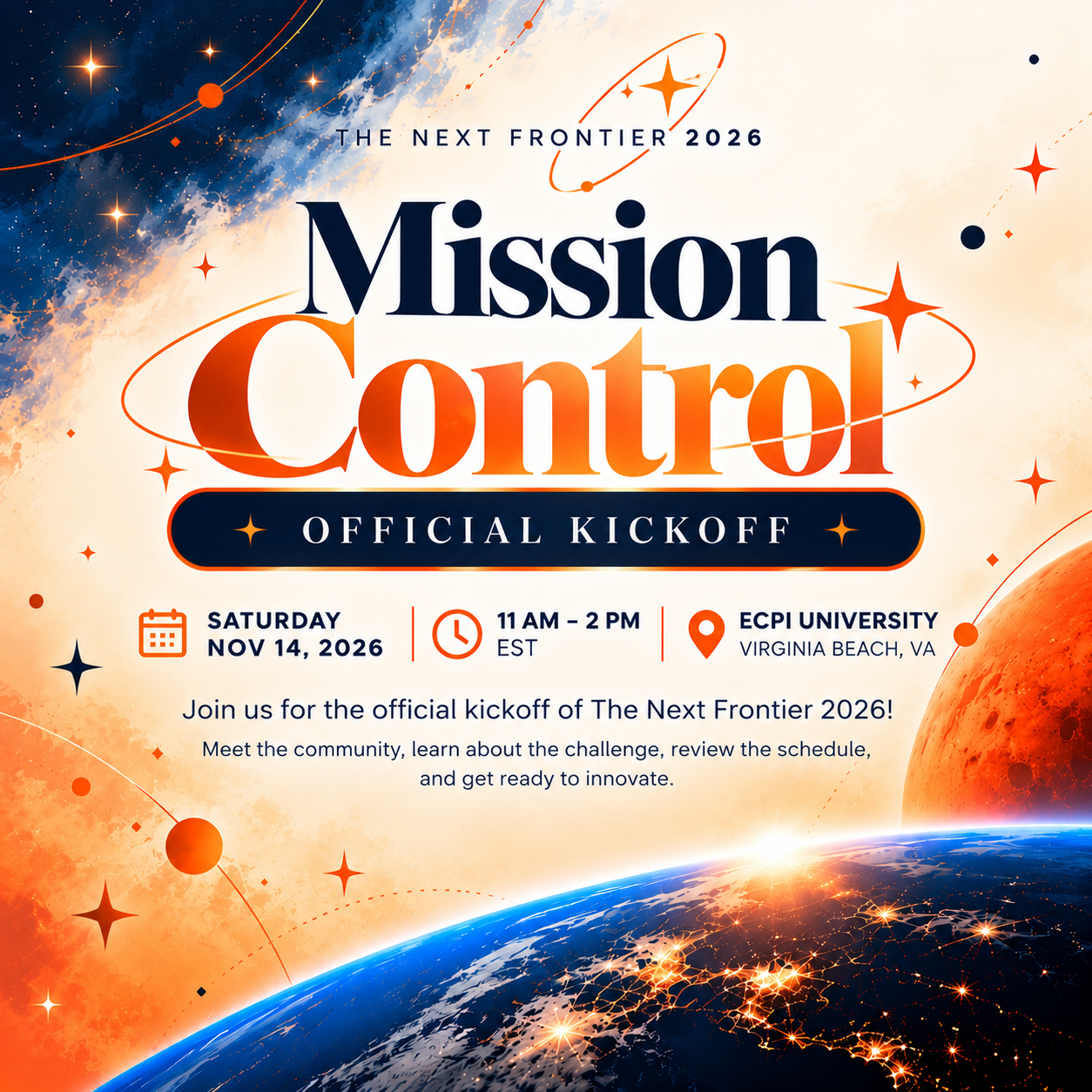 Step 1 · Day 2 · Sat Nov 14, 11 AM–2 PM
Mission Control
Pitch, Explore & Collaborate. Our official kickoff at ECPI University, Virginia Beach — share early ideas, get feedback, and meet potential teammates. No polished pitch required.
Register on Luma ↗RSVP on Meetup ↗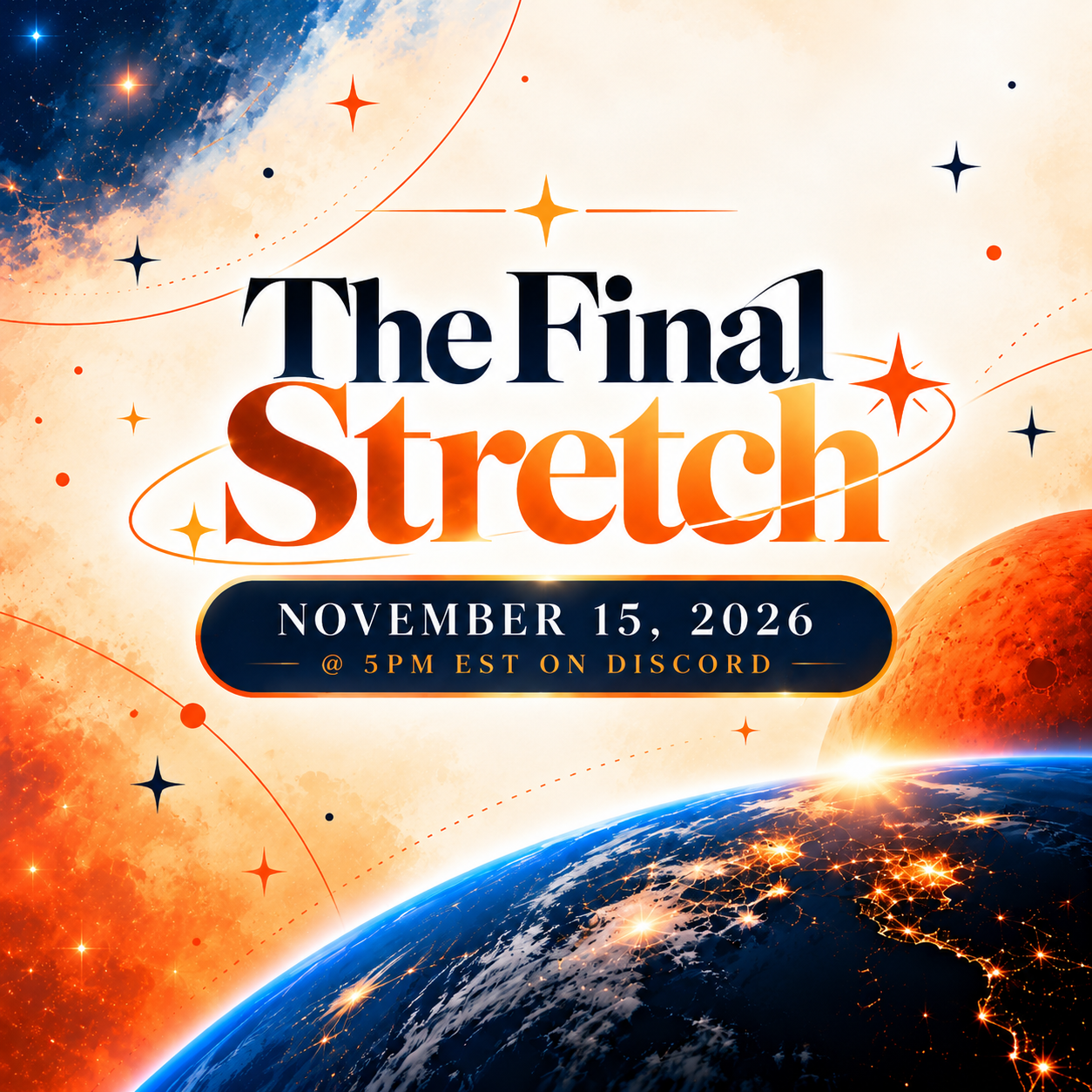 Step 1 · Day 3 · Sun Nov 15, 5 PM
The Final Stretch
Online via Discord. Reconnect with participants, share progress, ask questions, and prepare for the final stage of the hackathon.
Join the Discord ↗Sign up on the NASA Space Apps website
Next, create your account on the NASA Space Apps Challenge website. Not sure how? Watch the short video below for a walkthrough. When you register, be sure to sign up for the Universal Event.
Video: how to register for the NASA Space Apps Challenge.
Come to ECPI for November 13 & 14
ECPI University · Virginia Beach campus
Friday, November 13, 2026 · 6–8 PM
Saturday, November 14, 2026 · 11 AM–2 PM
5555 Greenwich Road, Virginia Beach, VA 23462
ECPI campus information ↗
ECPI University · 5555 Greenwich Road, Virginia Beach, VA 23462
Room, parking, transit, and accessibility details will be confirmed before the event.
Contact Erin Joel Moore at erinjoelmoore@gmail.com.